Tracking Horse Stories with the Reed Clan
Son of the Wind
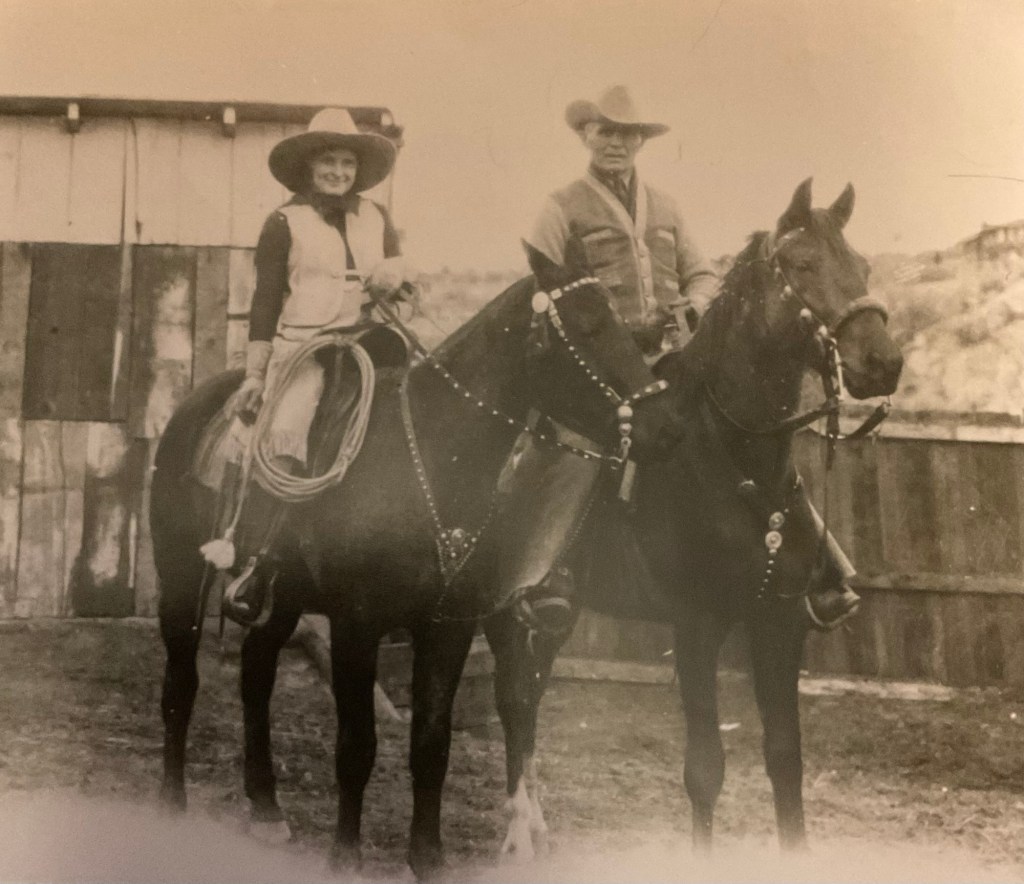
I come from horse people, my Father, Harry T. Reed was a horse trainer, and Appaloosa Breeder of World Champion Horses, and honored in the Appaloosa Hall of Fame. My grandfather Frank D Reed was a cowboy who rode on the cattle trails in Colorado in the days before there were fences. My dad had five brothers and five sisters and he was right in the middle. Nearly all of his siblings were also in the Horse Business, as well as plenty of cousins, from rodeo to thoroughbred racing. I began to wonder, what has been passed down in the Reed line. So I began looking for horse stories connected to the areas of Scotland where the Reeds were known to have come.
The surname Reed, means Red and originates in Scotland around the 14th century. Plenty of my Reed Aunts had Red hair, as does my older sister. Aberdeenshire is one of the areas in Scotland where the Reeds first appeared, and it is here where I began to find horse stories that were beyond my imagination. My own grandfather is known as a horse whisperer, who trained a wild mustang into a flashy cutting horse that eventually became a world champion polo horse.
Mystery surrounds this horse who was called Son of the Wind, because he was born in a blizzard in Winter, outside of foaling season. A spirited horse indeed, no cowboy could break the young mustang.
In the early 20th century, Buckskin Charlie was chief of the Southern Utes in the southwestern corner of Colorado. He was also a notorious horse trader, who occasionally raided herds of the Dine’ people on the Navajo Reservation in New Mexico. When the Altman ranch in Lincoln County, in Southeast Colorado, bought 50 Ute broncs from Buckskin Charlie, a shipment of Navajo Mustangs were delivered instead. In cowboy terms, the Mustangs were a lightweight smaller breed to the Castillo Spanish horses the Utes often traded, and the Altman riders unloading the mustangs in Colorado Springs figured “they got stang”. The mustangs were turned loose on the Altman Ranch and there Old Shorty was born. Most Colorado range mares foaled in the Spring or Summer, but Old Shorty was born in a blizzard in November. Luckily a couple of cowboys heading home from the range came upon them and brought them to the ranch where they were sheltered and fed through the Winter.
The Altman riders gathered around the chuck-line for dinner one evening perched on a corral fence watching Old Shorty feuding with a bull calf in the corral. They began talking about his genealogy and the fact that he was born out of season. One vaquero from Baca county proclaimed, Aqui esta un hijo del viento! Behold a Son of the Wind!
You see the cowboys all knew that there had been a movement to eliminate inbred Stallions in order to upgrade their horse herds. Cattlemen from Horse Creek to Cheyenne Wells agreed to remove all stallions from their ranges, only permitted to run with the herd at certain times of the year. Son of the wind could mean fatherless, or a speedy footed racer, Old Shorty Qualified on both counts .
A Portuguese Legend goes “when the west wind blows, mares set up their tails and turn them full against it, in order to conceive that genital aire in steed of natural seed; in such sort as they became great with-all, and quicken in their time & bring forth foals as swift as the wind.”
Old Shorty was turned out on the range with the herd for two years, who kept mostly to himself, earning the title of a Cimarron Mustang, and an altogether rough and wild Bronco. He had grown strong and muscled, and stood at 14 hands and 800 lbs. A Blood Bay with Four White Stockings, and the short-coupled back of his Arab Ancestry, which all mustangs can claim.
Bronc Busters were brought into to break the two and three year old wild herds, and ride out the raw stuff. These Bronc Busters were very good riders but not good horsemen, and sometimes much meaner than the broncs they busted. They mishandled him from the start, and he fought them tooth and hoof in a frenzy of fear and rage. After a few weeks the busters quit on Old Shorty in disgust. They couldn’t learn him a damn thing. He was a bawling, bucking, son of a blizzard. A spoiled horse.
He was put up for Auction and his reputation proceeded him with hardly anyone bidding, except for Frank Reed who bought him for $26. My grandfather bought Old Shorty, knowing he was dubbed a spoiled horse, and no one could break him. Frank Reed was known as a right salty cowhand and a good rider, but he was also a good horseman, which is something entirely different. He may have seen something in Old Shorty the other men could not.
My grandfather took the horse and put him in a small barn, and made his bed alongside the horse, and slept there until the horse recognized him as kin. He brought him the best oats and hay and fed him from his hand. The horse learned to trust him, and that his hand was not there to harm him. Eventually the re-training began, and always with gentle respect, and a whisper, the mustang named Old Shorty, was never parted from his new teacher. Old Shorty became a faithful cutting horse on the Cattle Trails, now weighing 900 lbs at 15 hands high. Shorty could cut on a dime and give five cents change, a real honest to gosh cutting horse. He was so gentle my Grandmother Nellie could ride him pregnant, with a toddler in her lap, and was seen riding all over the county unescorted.
A Bet Without a Bit
Frank Reed was on a beef drive of 900 steers in 1917, from the Altman Ranch to the Santa Fe Railroad at Rocky Ford. He took Old Shorty as his Night Horse, and at no time did he picket the horse, who was always found grazing peacefully by the chuck wagon until time to go on night watch with the herd.
When the herd reached Rocky Ford, 300 hundred were to be held in the feed lots of the American Sugar Company to fatten on grain and sugar beet pulp. The other 600 were to be shipped to market. The range cowboys held the herd, while the Sugar riders cut the feeders. It was a sorry exhibition to the cowboys, when the herd was stirred up on the verge of a stampede, with no steers cut out yet. Frank Reed, exasperated, bet a dollar he could cut a Steer in one minute into the scale pen for weighing, but without a bit in Old Shorty’s mouth. The president of the Sugar Company sitting on the top rail of the corral, called the bet. Reed removed the bridle bit, rode into the herd, and cut a feeder in forty seconds. The Sugar Magnate called it a fluke and offered Reed a dollar for every steer per minute he could cut into the scale pen.
Reed and Old Shorty went to work and cut 27 steers in 27 minutes into the scale pen. When his opponent admitted the spectacular feat was more than luck, he then offered $200 for the horse, but Reed would not sell. The Son of the Wind was eventually sold for $3500 to one of the world’s greatest Polo Players, Tommy Hitchcock. In 1924, Old Shorty played for the U.S against Great Britain in the international polo championship at Meadowbrook and helped score the winning goal for the U.S.
My father was a world champion horseman much like his father, who became so masterful in training horses, he boasted a money back guarantee to train a horse in three days. He could deliver a trained horse so in tuned, the rider could steer the horse with only their feet.
The Horsemen’s Word
The roots of the Reed Clan in Aberdeenshire, Scotland unfold with horsemen as members of the Society of the Horseman’s Word. Those Horsemen skilled as horse trainers, were sometimes seen as magical figures. Tales were passed on about ways they gained mastery over the horse. The Society of the Horseman’s Word in Aberdeen, Scotland, would invite initiates to their rites through the mysterious appearance on their beds of an envelope with a hair from a horse tail in it.
If the initiate accepted the invite, he would arrive in a secret location with offerings of whiskey and bread. Once there he would be blindfolded and led through a series of questions and rituals and threats to the initiate. The one piece of real knowledge embedded in the ritual, was the Horseman’s word, some say it was the Latin “sic jubeo”, meaning “I conquer this way”. The secret rites resemble Freemasonry with secret rites and rituals that accompanied entrance into the craft. Being invited to join the Society of the Horseman’s Word was a mark of distinction.
Those skilled with horses were viewed as having occult origins.
“Initiates were believed by some to have practiced forms of folk magic or witchcraft. In East Anglia, horsemen with these powers were sometimes known as ‘horse witches’ or ‘horse-warlocks’ or ‘whisperers.’
It has been speculated that these initiation rituals were derived in part from the witches sabbat, or from published accounts of witches and their ceremonies.”
Some speculate the Horseman’s Secret Society was a survival of an ancient pagan cult that had been persecuted in the witch trials in the Early Modern period.
“The Society of the Horseman’s Word originated in Scotland, and it is thought that the practices associated with the Society entered into East Anglia with Scottish prisoners of war from the Civil War era. With no possibility for defeated soldiers to be repatriated, many of them settled and sought work in our region. This theory gains credence from the fact that there is no evidence for the existence of the Society and its practices in East Anglia prior to the 17th century.”
In East Anglican Suffolk, the skills of horsemen were tied to their connection to animals that have been known to possess magical qualities such as the Toad. Stories surround the so called Toadmen and Toadwomen of their rites, such as acquiring a bone from a toad that gives power over man and beast. The bone is buried in the Earth and then taken then taken to a stream at midnight, under the moon. The toad bones are thrown into a stream running and watching for the ones that would separate from the others and float upstream, a mark of holding potent powers.
Toad bones often appear in spells and stories of horses. The bones could be used to halt a horse, until released it from the spell. There were also certain secret elixirs and unguents that could influence horses. Rubbing a magic potion on the hand or on the horse itself, could move the horse along or bring it to a halt. One tip from the gypsy horse coppers was to carry a ball made from oats and honey to curry favor from the horse.
Horse Dreams
My interest with horses and my Scottish Ancestors comes from growing up on an Appaloosa Breeding Ranch in West Texas under my father’s shadow, learning all I could from him about riding, training, breeding and caring for horses. I was always surrounded by plenty of horses, but none of them were mine. I had horses I could ride all I wanted, but it wasn’t mine to keep. So many horses I loved deeply were sold out from under me, and broke my heart. I even was a surrogate mother to a couple of beautiful leopard Appaloosa colts, when the Mare died giving foal, both were sold after I had halter broke them.
Eventually, I began seeing horses showing up in my dreams, and one night, a particular dream showed up of a magical colt born from my Father’s brood mare, Princess Valley. The colt was black and had a white heart on his forehead. I called my Dad first thing in the morning and asked if his Mare had foaled. Long pause, how did you know that, he asked? I dreamed it last night. I went over to visit the new born colt, and my Dad took me to see the empty stall where it was born. He said, when the colt was born, he jumped up on his feet and ran into the gate. I named him Calamity. Now my turn for a long pause, I was dumbfounded, because that is what my dad used to call me as a child. Where is the horse now? I asked. He took me to the corral where the colt was nursing under his mother. He stopped and looked up to see me, and began walking straight over to me, to sniff me out. My Dad stepped in between us. He was afraid once we connected we would never be parted. I said, you have to give me this horse, you know it belongs with me. He just stood there and said, I’m sorry but I already sold it. There it is again that heartbreaking loss. I would find out later, after years had gone by, that he did not sell the horse, but gave it to his ex-wife. She posted a photo of it on Facebook after he died. I recognized the horse, as the one from my dream, who had been coming into my dreams all these years as a protector and guide.
Sources
Adapted from Western Horseman Magazine “Son of the Wind” article by Harry Galbraith
https://www.horsemansword.org.uk/the-society-of-the-horseman-s-word/

